Apsara Afsanesara - Persian Dance and Beyond


Persian Dance
Persian dance is a blend of lyricism, coy charm, emotion, and a touch of dreamlike unreality.
The dancer enchants the audience with refined gestures, spectacular turns, and delicate expression — gliding across the stage like a butterfly, weaving stories of love, longing, beauty, and sorrow. Light as a silk veil and graceful as a gazelle, she becomes the embodiment of the poetic ideal of Persian culture.
Persian culture is one of the oldest living cultures that continues unbroken to this day. Its unique aesthetic — in both visual arts and music — directly influenced most of the Silk Road regions, from the Arab Maghreb to India and China.
Unfortunately, unlike Indian or Chinese dance traditions, the dances of ancient Persia have not survived to our time. Yet we have reasons to believe that dance once held an important role in Persian society (according to Plutarch, it was through dance that the Persian princess Roxana captivated Alexander the Great). After the Muslim conquest, dance disappeared from public life, but it continued to develop in private homes and royal harems.
Today, the dances of Iran can be divided into four groups:
-
Line and chain dances, which include most folkloric dances
-
Ritual dances, connected with Sufism and erfan (Islamic gnosis and mysticism), as well as ritual war dances and the zar tradition
-
Urban social dances, such as baba karam, shateri, and contemporary Persian pop
-
Virtuosic solo improvisation, including reconstructed court dances, the neoclassical style, and other modern styles
Persian dance is defined by grace and fluid movement. Unlike Oriental dance (“belly dance”), with which it is often confused, Persian dance focuses primarily on expressive arm and torso movements.
The movement is elegant, airy, and subtle — yet it does not lack rhythm. The footwork is closely tied to the most common rhythm in Persian music (6/8) and strongly resembles the steps of a waltz.
Persian Neoclassical Dance
Persian Neoclassical Dance is often called the “ballet of the Orient.”
It began developing around the 1970s and is a style that blends traditional Persian footwork with steps from other Silk Road dances, along with influences of Classical Dance (ballet) in its aesthetics, as well as a contemporary Western approach to musical interpretation — hence the term neo-classical.
This style also places strong emphasis on emotional expression.
Neoclassical Persian dance is the most spectacular and elegant form within the Persian dance tradition.
It is characterized by fluid transitions, rich use of space, and very feminine work of the arms and torso.
It is typically performed to classical or contemporary Persian music that is rooted in classical principles.
The dancer becomes the embodiment of the music, reflecting all of its subtleties while gliding across the stage like a butterfly.
This dance can be performed with props such as zanguleh (metal castanets), veils, tambourines, daf (a Persian frame drum), or two handkerchiefs.
If you want to feel like a princess from an oriental fairy tale — Persian Neoclassical Dance is perfect for you!
photo: Marta Pietkiewicz


Qajar Style of Persian Dance
Also known as “Kereshmeh,” this is a reconstructed court dance from the era of the Qajar dynasty (18th–20th century).
It was traditionally performed by professional female dancers called motreb.
This refined style is deeply rooted in Persian dance technique and grew out of popular social dance traditions.
It is characterized by a contrast between soft, flowing movements and sharp musical accents created through small, controlled gestures.
A key element of this style is the distinctly Persian form of coquettish expression known as “naz.”
You will also find touches of pantomime woven into the choreography.
The dance may be performed with zang (Persian castanets similar to Arabic sagat/zills), nalbeki (small tea saucers played rhythmically using thimbles — a tradition originating from Azerbaijan), small tea glasses, or a tambourine.
Qajar Dance is an excellent choice for anyone wishing to experience the characteristic “Persian technique” in its purest and most authentic form.
photo: Karolina Byrska
Persian Pop
Persian Pop / Majlesi is a contemporary social dance style that grew out of Tehran’s cabaret scene, traditional regional dances of Iran, and the Persian diaspora in the West.
It is light, joyful, and based on traditional Persian dance technique, performed to popular music in a 6/8 rhythm.
This style is perfect for anyone who prefers something more relaxed and traditional — and for those who simply want to have fun :)
Photo: Karol Rzeczycki


Regional Dances of Iran
Iran is home to many different ethnic groups, each with its own language, culture, traditions, clothing — and of course, dances.
Regional dances are usually connected either with the celebration of events such as weddings or New Year, or with religious rituals or the agricultural cycle.
These dances are most often performed in a circle or in a line (though not always).
Among the most popular regional dances of Iran, we can distinguish:
-
Kurdish – Kurdistan is a region divided between Iran, Iraq, Turkey, and Syria. Although the Kurds do not have their own state, they have a distinct culture and traditions reaching back thousands of years. The dance called Halparke is performed in a line, with everyone holding hands. It focuses on lively, bouncing footwork and pulsing arm movements. In the line, men and women stand alternately, symbolizing their equality.
-
Ghassemabadi – Gilan, where the village of Ghassemabad is located, is a province on the Caspian Sea, known for ideal conditions for growing rice and tea. Dance from this region is heavily based on pantomime depicting fieldwork. A characteristic element of the traditional women’s costume here is a wide skirt decorated with ribbons, which lifts beautifully during turns.
-
Bandari – Bandari literally means “from the port.” This group of dances comes from the Persian Gulf region, mainly from port cities such as Bandar-e Abbas, Ahvaz, and Bushehr. These dances show clear influences from Arabic and East African dance traditions, and the region is home to both Arab and Afro-Iranian minorities.
-
Bojnurdi – Bojnurd is a city in North Khorasan, where the dominant ethnic group is the Kurmanji Kurds. Throughout Khorasan, circle dances are very common, as well as dances with sticks — some originating from ancient war dances, others from agricultural rituals.
-
Qashqai – The Qashqai are a Turkic ethnic group living in central Iran. Their women’s dances are very calm and gentle. A distinctive feature is dancing with two handkerchiefs, one in each hand. Similar dances are also found among two other ethnic groups in the region — the Lors and the Bakhtiaris.
-
Azeri – Azeris are the largest ethnic minority in Iran. They have a rich tradition of both group (line) dances and solo dances, for both men and women. Aesthetically, they are close to the dances of other nations of the Caucasus.
photo: Jacek Karczmarczyk

Dances of Afghanistan
Dances of Afghanistan and Balochistan:
Culturally and geographically, Afghanistan lies at the crossroads of three major spheres of influence — Persian (Iran), South Asian (Pakistan), and Central Asian (Tajikistan and Uzbekistan).
Because of this, Afghan dance contains elements from all of these traditions.
Every ethnic group and every region has its own distinctive dance style.
Afghan dances are characterized by small, delicate footwork such as tombe (called "Maida") and subtle hand gestures in which the dancer conveys modesty and gentle shyness.
Due to the country’s turbulent history, Afghan dance was never formally codified, but we can distinguish several regional forms:
-
Herati – Herat, the “Pearl of Khorasan,” is one of Afghanistan’s most “Persian” cities; it was once home to the Persian intellectual elite. Its atmosphere historically fostered art and scholarship, echoes of which survive in its dance and music.
Herat dance aspires to be the heir of Afghanistan’s court traditions and those of the Indian Mughal Empire.
It is delicate, refined, and known for its subtle wrist movements. It may not be the most surprising dance, but it is certainly the most sophisticated of all Afghan styles.
It is also the most coquettish — the dancer expresses the Persian concept of naaz, a shy, modest flirtation.
Like classical Indian and Iranian dance, it contains pantomime elements: the dancer may symbolically mimic applying makeup, combing hair, embroidering, or even… flying kites.
This dance is always performed solo. -
Logari – Logar is a valley and province southeast of Kabul.
The Logari dance is primarily a form of celebration at weddings and festive gatherings.
Musicians intentionally create sudden, unexpected pauses in the music.
Movements are more energetic, the rhythm shifts frequently, and fast spins with abrupt stops are common, adding excitement to the dance.
Women, of course, dance it in a much gentler manner than men.
This style is danced mainly by Pashtuns. -
Qataghani – A dance performed mainly by Tajiks.
Today it is one of the most popular styles used in contemporary Afghan pop music.
The dance is rhythmic, cheerful, and an essential part of Afghan weddings. -
Attan – The national dance of Afghanistan, performed by both men and women.
Its roots lie in the war rituals of nomadic Pashtun tribes.
It is danced in an open or closed circle and is characterized by complex rhythms and sudden spins.
A special variant is Chub-Bazi, a version of Attan danced with wooden sticks that are tapped together. -
Balochi – Balochistan is a region divided between Iran, Afghanistan, and Pakistan.
Balochi dances contain influences from all three cultures — and, surprisingly, from Persian Gulf dances (the Khaliji group) and even certain African dance traditions.
The Baloch have many dances, including Do-chapi (a circle dance) and Leva, a dance originating from trance rituals.
Photo: Abhi Kagathara
Dances of Uzbekistan
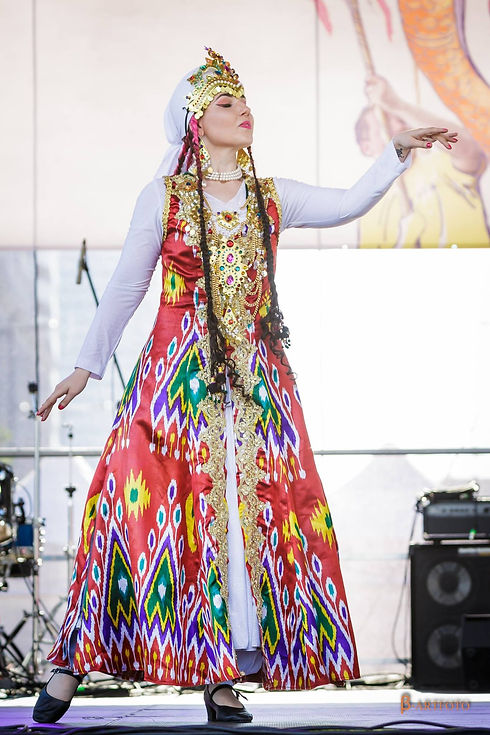
Uzbekistan is a Central Asian country renowned for its refined dance culture. Within Uzbekistan, there are three main schools of national dance:
-
Fergana – A mostly lyrical dance style from the Fergana Valley, similar in character to Persian dance. The favorite musical genre for this style is Tanovor — a lyrical song expressing the emotions and inner turmoil of a woman longing for her beloved.
-
Bukhara – A dance from the former Emirate of Bukhara, a region inhabited by both Uzbeks and Tajiks. It originates from the Sozanda tradition — professional female music-and-dance troupes who performed at family celebrations. Bukhara dance is fast, precise, and often includes acrobatic elements.
-
Khorezm – A dance from the former Khivan Khanate, a region located near the Turkmenistan border. This energetic style has roots in shamanic dances. Its movements are inspired by nature and often imitate the behavior of animals. The dance features dynamic shaking of the wrists (decorated with bells), shoulders, and head.
Beyond these three main schools, Uzbekistan also has a Classical style (a fusion of Fergana dance and elements of ballet) as well as a variety of regional dances such as Surkhandarya, Kashkadarya, and others.
Photo: B-art photos
Dances of Georgia
Georgia — or rather Sakartvelo, as it is called in the language of its people — is a country lying at the foot of the Caucasus, known for its unique culture and art. Georgian dances express the lifestyle of the region’s inhabitants, who often differ greatly from one another in terms of climate, culture, and customs. The dances portray social relations, holiday celebrations, heroic battles, courtship between partners, as well as the beauty of refined arm movements and intricate footwork.
They are primarily group dances, but duets, virtuosic solos, and circle dances such as Perchuli often appear in performances. Below are examples of some of Georgia’s most popular dances:
Adjaruli - Also known as Gandagana, this is one of Georgia’s most popular dance styles, originating from Adjara — a region on the Black Sea bordering Turkey. It is characterized by carefree joy and playful flirtation between the dancer and the male partner. The movements often reference the nature and landscape of Adjara — the waves of the Black Sea or the winding paths leading up the mountains. Sometimes it includes humorous elements.
Kartuli - One of the most important and also one of the most difficult Georgian dances. Its name literally means “Georgian.” Traditionally, it is a couple’s dance through which young people could get acquainted with potential marriage partners. Today, it has become a popular first dance at weddings. Of all dances, it most deeply reflects the spirit of Georgian culture and its gender roles:
she — modest, gliding across the stage like a swan;
he — proud, expressing his love through precise footwork…
both elegant, dignified, and restrained.
Davluri - A court dance whose name likely comes from davla — a walking dance step. It is an elegant dance performed by many mixed couples. Calm and static, it is often used in performances as a prelude to Kartuli.
Tbilisi Folklore - Tbilisi, located at the crossroads of cultures and trade routes, is known for its high culture, arts, and vibrant subcultures that inspire contemporary choreography. Historically, two groups shaped the city’s folklore:
-
Kinto — small merchants known for acrobatic tricks and balancing a wine bottle on the head (they inspired the dance Kintauri),
-
Karachokheli — honorable craftsmen, lovers of poetry, wine, and the rose, a role often embodied by the female dancer.
Tbilisi has always been a multicultural city where Georgians, Armenians, and Azeris have lived side by side. Inspired by this blending of traditions, the dance Jeirani was created — combining Oriental elements with Tbilisi folklore, with the female dancer portraying a girl enchanted into a timid gazelle.
Rachuli - Also known as ogro-chogro, this is a joyful, humorous dance from the region of Racha at the foot of the Caucasus in western Georgia. Racha is known for its vineyards, hospitality, and the hard work of its people. The dance is carefree, often comedic, and frequently depicts everyday scenes such as youthful flirtation or a marital quarrel.
Mtiuluri — Mountain Dances - A whole category of styles from the regions of Tusheti, Khevsureti, Kazbegi, and Mtskheta-Mtianeti. Despite subtle local differences, these dances are characterized by virtuosic male displays and energetic yet delicate women’s movements. Mtiuluri dances showcase the indomitable spirit of Georgian highlanders — their lifestyle, strength, and bravery.
Abkhazuri - A lively folklore dance from Abkhazia, performed at a very fast tempo. Both male and female dancers demonstrate complex footwork with extraordinary lightness. In character, it resembles the mountain dances.


Dances of Tajikistan
Tajikistan is a country in Central Asia and a direct heir to the culture of the eastern part of ancient Persia. There are many regional dance styles in Tajikistan, including:
-
Khujandi – A dance from the city of Khujand, located in the Tajik part of the Fergana Valley. Its style is very close to the Fergana Uzbek dance.
-
Kulobi – A style from the Khatlon region. This dance is characterized by a heavy 7/8 rhythm and loose costumes with long, wide sleeves, which the dancer uses playfully as a prop. The dance also includes acrobatic elements.
-
Zarafshoni – A style somewhat similar to Kulobi. The dancer often flirts with the audience by peeking from behind the veil and sleeves.
-
Badakhshani – A dance from the Pamir Mountains. It has trance-like roots, beginning with slow, winding movements. The tempo of the music and dance gradually increases, culminating in ecstatic spinning. The dancer often incorporates gestures inspired by the nature of the Pamirs.
-
Shashmaqom – Considered a classical dance style in Tajikistan. It is a sister style to classical Uzbek dance, combining elements of the Khujandi and Bukhara styles with ballet technique.
Because the border between Tajikistan and Uzbekistan is relatively recent in the context of Central Asia’s long history, dances from Bukhara and Samarkand are also performed in Tajikistan — cities where Uzbeks and Tajiks have lived side by side for centuries.
Other Central Asian Styles
Apsara has also had the opportunity to study several other dance styles from Central Asia, including:
-
Uyghur Dance – The Uyghurs are a Turkic ethnic minority living in the autonomous region of Xinjiang (also known as East Turkestan). Closely related to Uzbeks, their dances aesthetically resemble those from eastern Uzbekistan, but feature a distinctive dynamic contrast between slow, flowing movements and sudden bursts. Uyghur dance expresses their cultural ideals — on one hand, pride, and on the other, a delicate, girlish shyness. Uyghur dances have been incorporated into Chinese ethnic dance traditions.
-
Kazakh Dance – Kazakhstan is a large country in Central Asia. This graceful dance reflects ancient times and traditions, with hand gestures depicting the nature of the steppes and the traditional way of life.
-
Turkmen Dance – Turkmen people are famous for weaving carpets and kilims, an art traditionally practiced by women. Women’s dances often use pantomime to depict the process of creating a carpet, while men perform the trance-like Khandjar, a circle dance with daggers.
Photo: alepieknyswiat.pl


Bollywood Dance
Bollywood Dance is the most well-known form of Indian dance in the West. Created for the Indian film industry, it combines elements of classical and regional Indian dances, other Oriental dances, and a variety of Western techniques such as hip hop and jazz. Bollywood is an explosive mix of emotion, precise gestures, dynamic steps, and captivating stories.
Before turning her focus to Iranian and Central Asian dances, Apsara trained for several years in various Indian dance styles and still occasionally performs Bollywood dance as well as Indian dance fusions.
Photo: Dorota Skowrońska
Ethno-Contemporary
Ethno-contemporary is an umbrella term for dance forms rooted in “ethnic” techniques — usually understood as non-Western stage traditions — used in contexts different from their traditional ones, such as contemporary dance theatre. It blends elements of dance from Iran, Afghanistan, and Central Asia with contemporary dance techniques, seeking new movement qualities and a new choreographic language. Traditional movement is reimagined to tell modern stories.

Grow Your Vision
Welcome visitors to your site with a short, engaging introduction.
Double click to edit and add your own text.